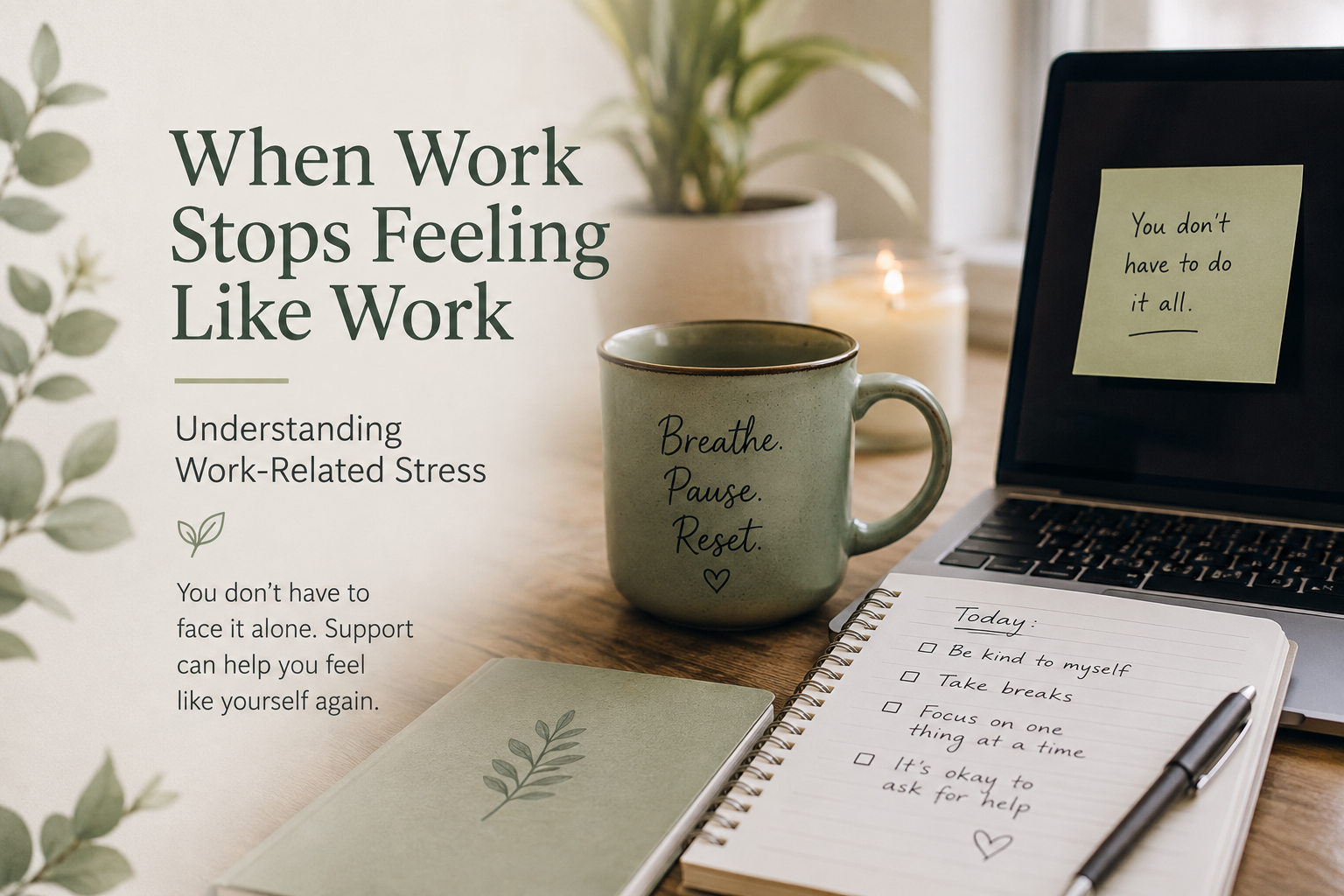
When Work Stops Feeling Like Work: Understanding Work-Related Stress
You used to cope.
The deadlines, the meetings, the emails, the pressure. You might even have thrived on being busy. But lately, something has changed.
You're exhausted before the day has even begun. You can't switch off when you get home. Your mind races at night, yet you struggle to concentrate during the day. Small tasks feel overwhelming, and you're beginning to wonder if you've lost the person you used to be.
If this sounds familiar, you're not alone.
Work stress isn't just about having too much to do
Many people assume work-related stress is simply about a heavy workload. While that can certainly contribute, stress often runs much deeper.
It might be that you're constantly trying to meet impossible expectations.
Perhaps you're carrying responsibility for everyone else, while no one seems to notice you're struggling.
Maybe you're working in an environment where you don't feel valued, supported, or psychologically safe.
Or perhaps you've spent so long putting everyone else's needs before your own that you've forgotten what you need.
Over time, your nervous system stays in a constant state of alert. Your body doesn't know the difference between an overflowing inbox and a genuine threat. Eventually, it starts asking you to slow down, and sometimes it does that in ways you can't ignore.
Signs that work stress may be affecting you
Work-related stress doesn't always look like having a breakdown. Often it shows up quietly.
You may notice that you:
- Feel anxious before work or on Sunday evenings.
- Struggle to switch off after your working day.
- Feel irritable or snap at those closest to you.
- Have difficulty concentrating or making decisions.
- Feel emotionally numb or disconnected.
- Lose confidence in yourself despite working hard.
- Experience headaches, poor sleep, muscle tension or constant fatigue.
- Begin questioning whether you're good enough.
Many of the people I work with tell me they keep pushing through because they believe everyone else is coping better than they are.
The truth is, many people are simply hiding how much they're struggling.
Sometimes work stress isn't really about work
Work can trigger deeper patterns that have been with us for years.
Perhaps you've always felt you had to prove yourself.
Maybe saying "no" fills you with guilt.
You might find it difficult to ask for help because you've learned that being independent is safer.
Or maybe criticism, conflict, or feeling like you've let someone down affects you far more deeply than you'd expect.
Therapy isn't about telling you to become more resilient or simply manage your time better.
It's about understanding why work has become so overwhelming and helping you reconnect with yourself beneath the pressure.
You don't have to wait until you're burnt out
One of the biggest myths I hear is:
"I'll get therapy once things calm down."
But often, things don't calm down on their own.
Stress has a way of becoming our normal. We adapt, we push through, and we tell ourselves it's "just a busy period."
Until one day, we realise we've been surviving rather than living.
You don't have to reach breaking point before asking for support.
How therapy can help
Therapy offers something many people don't have, a space where you don't need to be productive, perform, or hold everything together.
Together, we can explore what's contributing to your stress, understand the patterns keeping you stuck, and help you build a healthier relationship with work and with yourself.
Many clients find they begin to:
- Feel calmer and less overwhelmed.
- Set healthier boundaries without guilt.
- Rebuild confidence in themselves.
- Understand and manage anxiety more effectively.
- Feel more in control of their emotions.
- Make decisions with greater clarity.
- Rediscover who they are outside of work.
Therapy won't remove every challenge from your workplace.
But it can change how you experience those challenges and help you feel more like yourself again.
You deserve more than simply getting through the week
If work has become something you dread, if you're constantly exhausted, or if you're wondering why everything feels so much harder than it used to, know that you don't have to face it alone.
Taking the first step towards therapy isn't a sign that you've failed.
It's a sign that you're ready to start listening to yourself.
If you're looking for therapy for work-related stress in Greenwich, London, or online across the UK, I'd be happy to offer a free 15-minute consultation. Together we can explore what's been happening and whether therapy feels like the right next step for you.